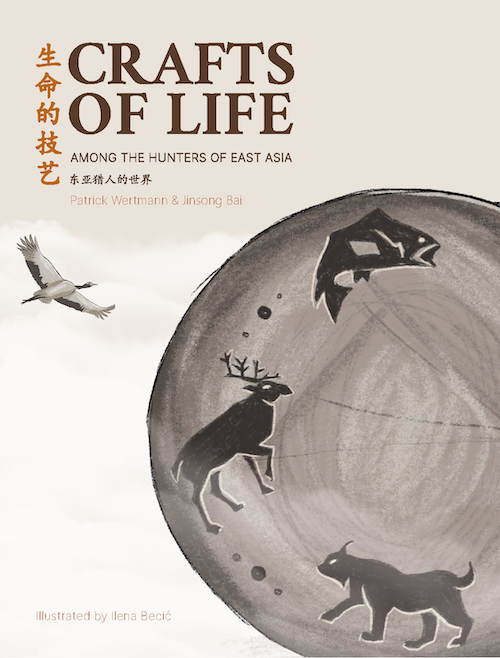
Crafts of Life: Among the Hunters of East Asia
Patrick Wertmann
Crafts of Life: Among the Hunters of East Asia
Zürich: Asien-Orient-Institut, Universität Zürich 2025.
Across the expansive landscapes of Hulun Buir and the Amur River Basin, generations of skilled craftsmanship have been shaped by practical necessity and deep ecological knowledge.
This region, spanning northeastern Inner Mongolia and Heilongjiang Province, is home to the Evenki, Oroqen, and Hezhe communities. Their ways of life have long been closely tied to the rhythms of forests, rivers, and seasons. Each group developed specialized techniques suited to their specific environments: the Evenki and Oroqen transformed leather and fur into warm coats, durable boots, and hunting gear, while the Hezhe fashioned fish skin into watertight clothing and everyday items along the waterways of the Amur. Birch bark was widely used across all three communities, crafted into containers, tools, and lightweight vessels. Shaped by environmental conditions and refined over generations, these techniques reflect complex systems of knowledge and adaptation that supported everyday life and were passed from generation to generation.
Today, these skills face considerable challenges. Rapid social and environmental change, coupled with breaks in the transmission of knowledge between generations, threatens the continuity of these material traditions. Museums preserve many tools, garments, and vessels, but without the contextual knowledge held within the communities themselves, these objects risk becoming disconnected from their cultural and functional significance.
Crafts of Life – Among the Hunters of East Asia presents a collaborative effort to bridge this gap, bringing together historical artifacts and contemporary knowledge holders. The exhibition, together with this guidebook, invites you to discover how natural materials were not merely resources for survival, but integral to sustainable and reciprocal relationships with local environments. From hide tanning and fish skin sewing to birch bark crafting, it reveals how technical skill, environmental awareness, and cultural values are interwoven in these material practices.